Zygossota · Retractor for zygomatic implant surgery
Follow this line.
You don't know what it is… yet.

This curve… is for your hand.
The grip is the 1.5 mm sheet itself, folded into a U. No welds, no seams.
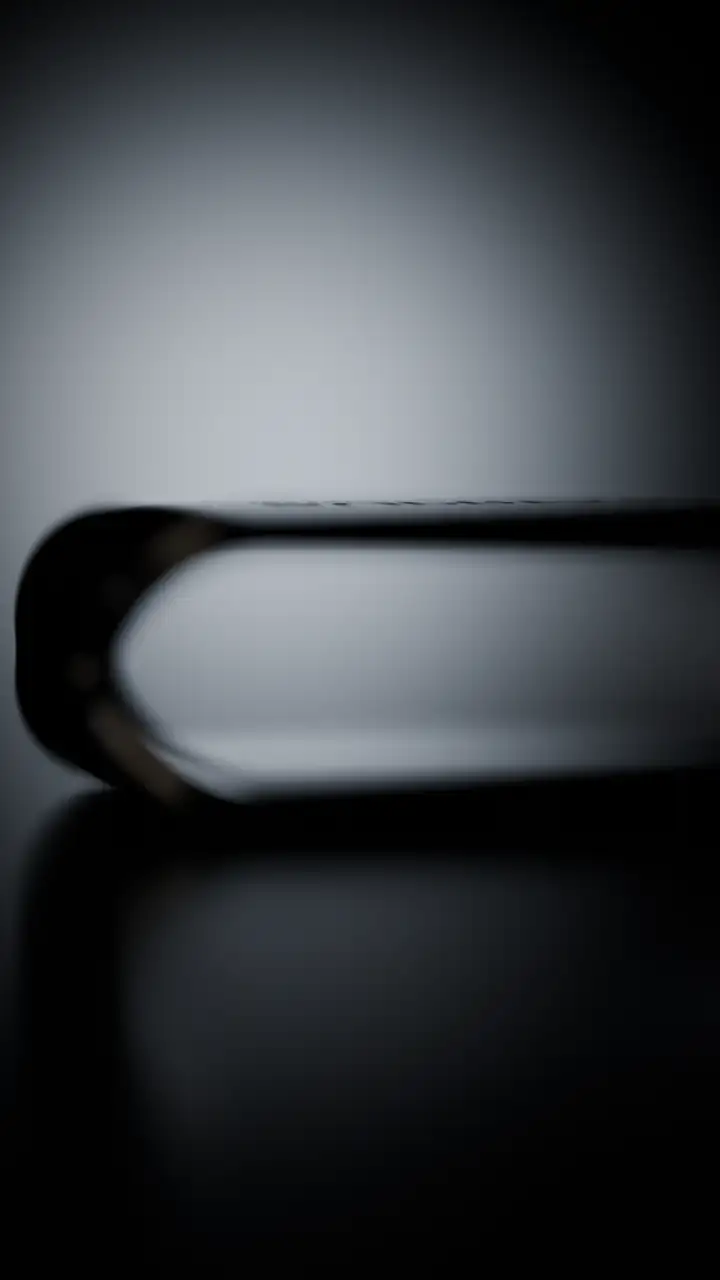
This one, for your thumb.
A shallow saddle on the grip, where the thumb rests and steers.

This one, for the lip.
The domed blade holds the lip the way a Minnesota does.
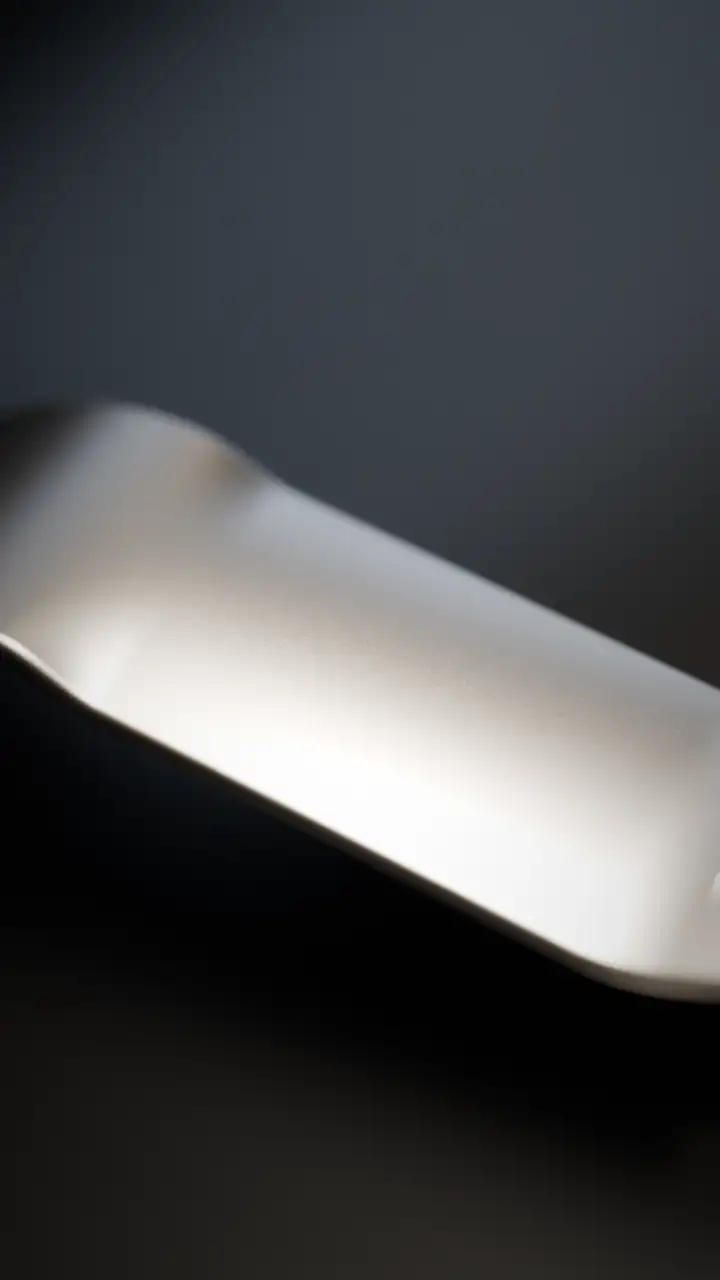
These two, for the bone.
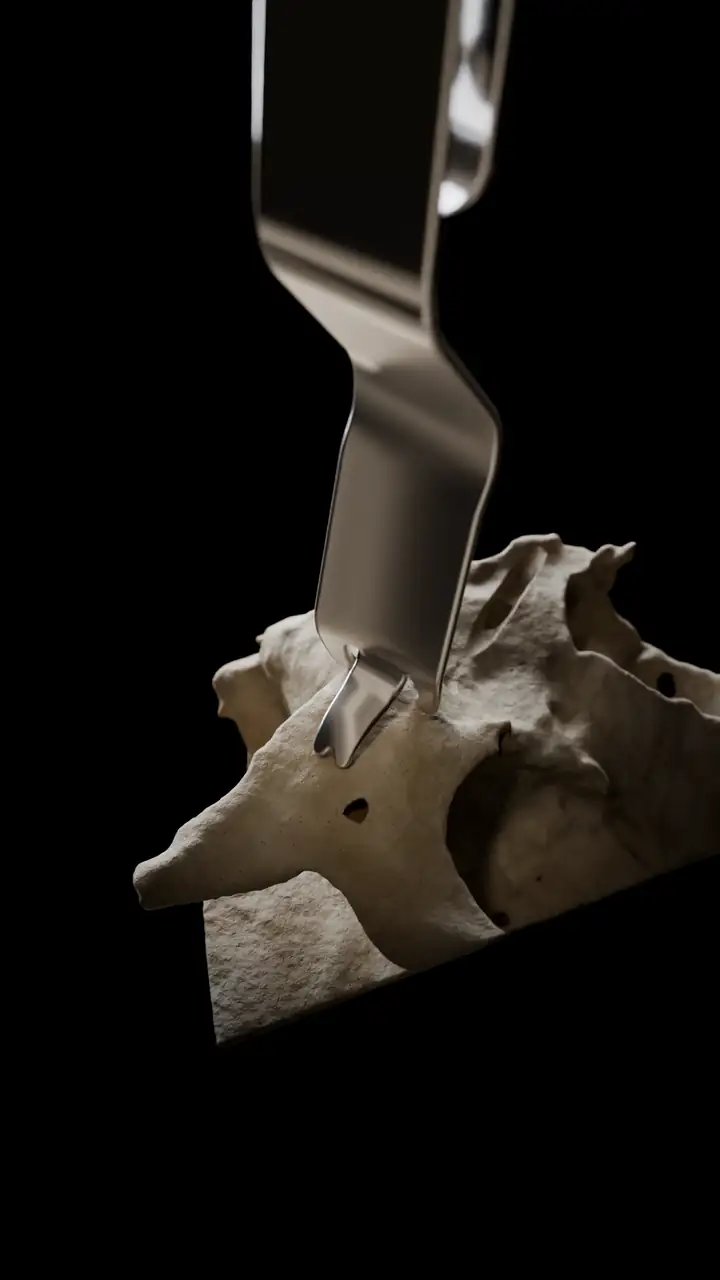
Two points of support on the bone keep the instrument steady.
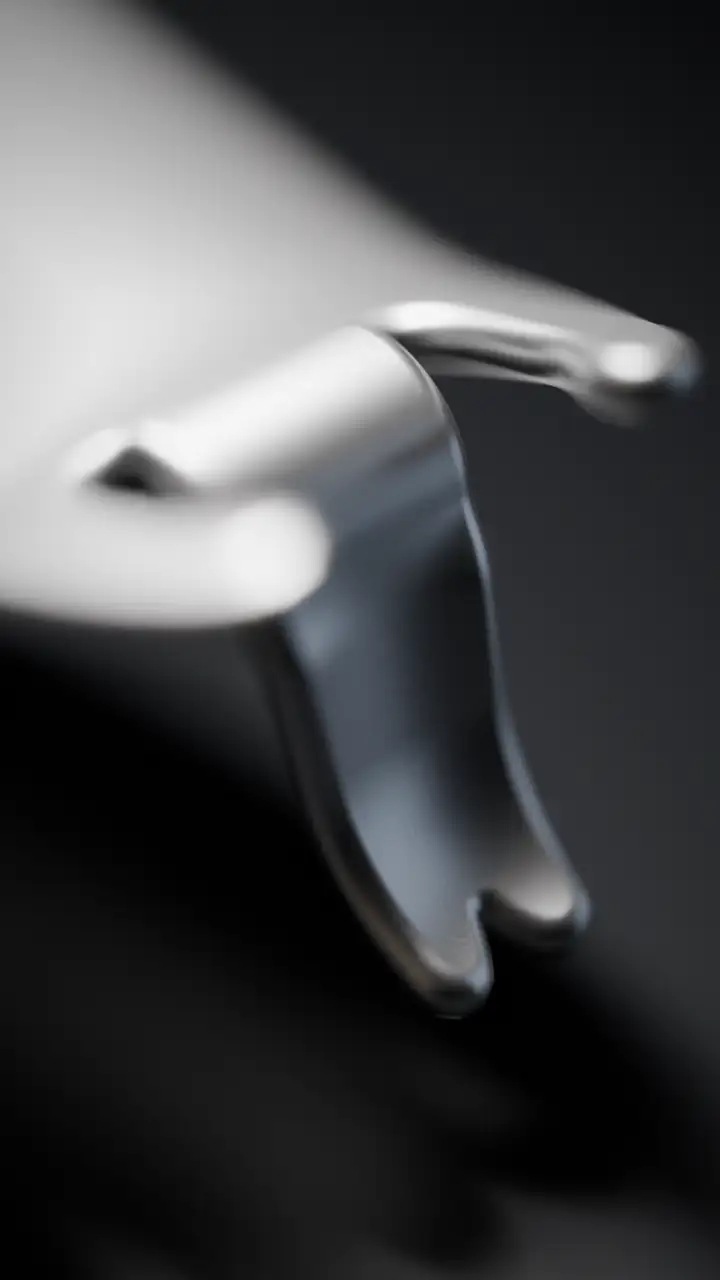
And this one… to protect the drill.
The tongue forms a tunnel under the flap. The drill exit stays in view and protected.
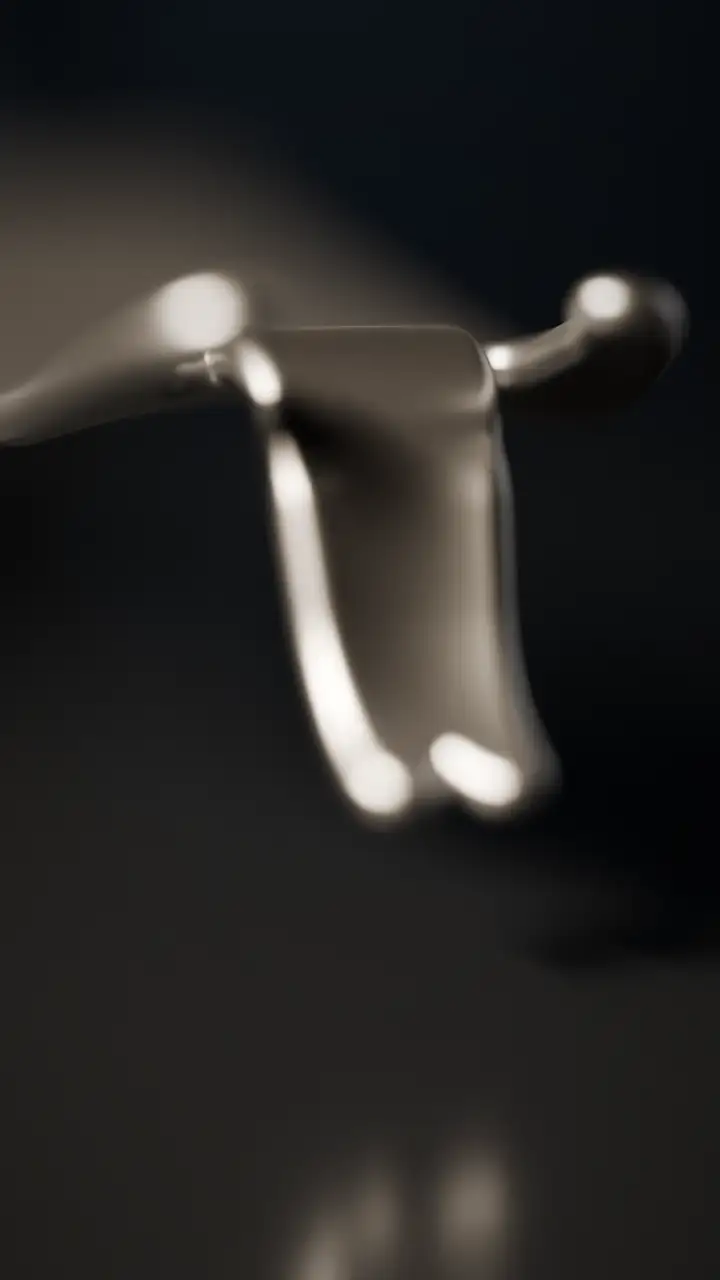
One line. From your thumb… to the zygoma.
It holds the lip, rests on the bone and protects the drill exit. One instrument, from one sheet of steel.
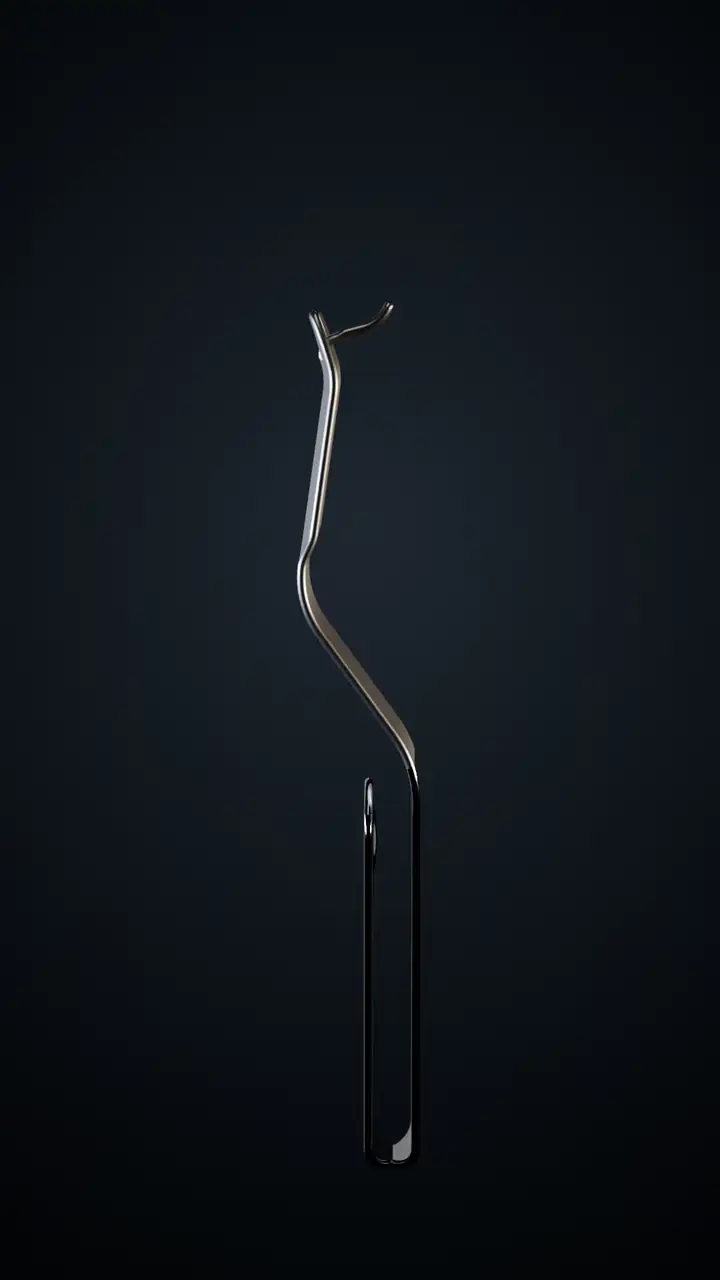
Like a Minnesota…but for the zygoma.
The same instrument works on both sides.
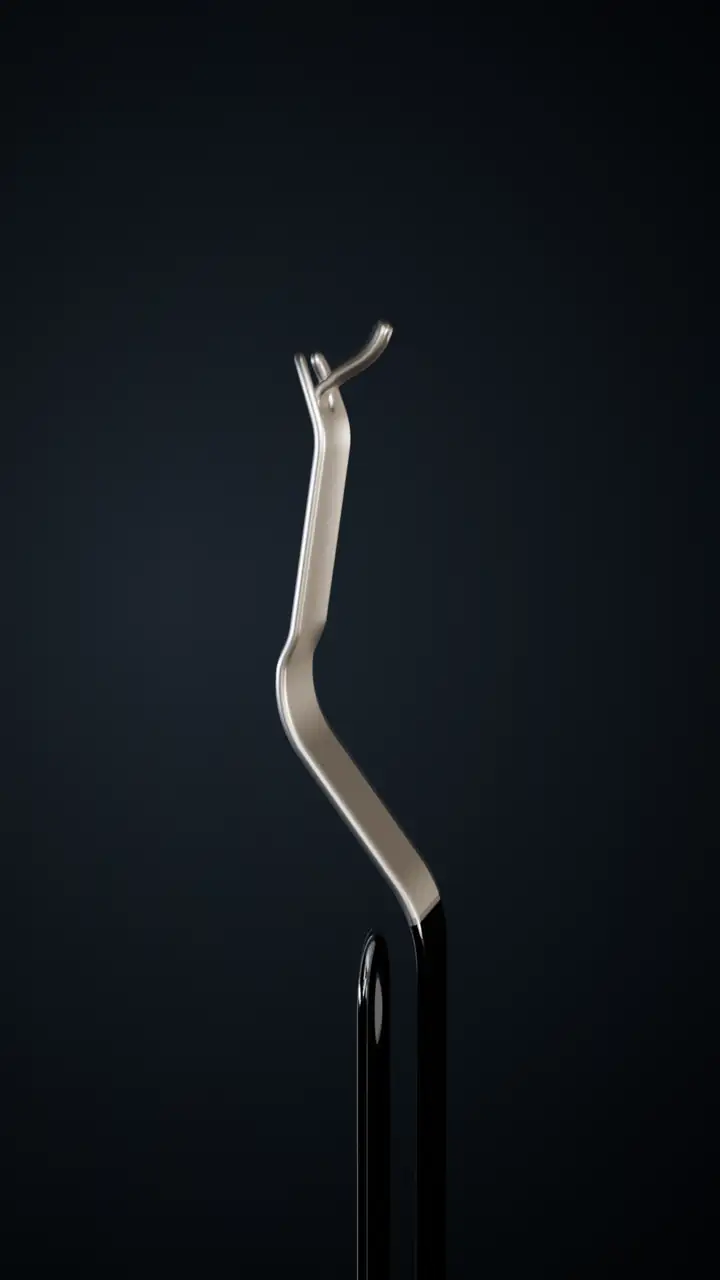
Zygossota™
Both legs rest on the zygoma. The tongue slides under the flap and opens the field. Light and irrigation reach the osteotomy, and you see the drill exit instead of guessing.
What is the Zygossota?
The Zygossota™ is a retractor for zygomatic implant surgery. Like a Minnesota, but for the zygoma: one steel plate that holds the lip, rests two legs on the bone and protects the drill exit with a tongue that slides under the flap. Three sizes, S, M and L, with the same grip; the same instrument works on both sides. Designed by Fernando Giovanella. Manufactured and sold by Supremo Instrumentos Cirúrgicos. Patent pending. In launch phase: sales depend on regulatory clearance by Anvisa (Brazil).
Nobody operates on the average
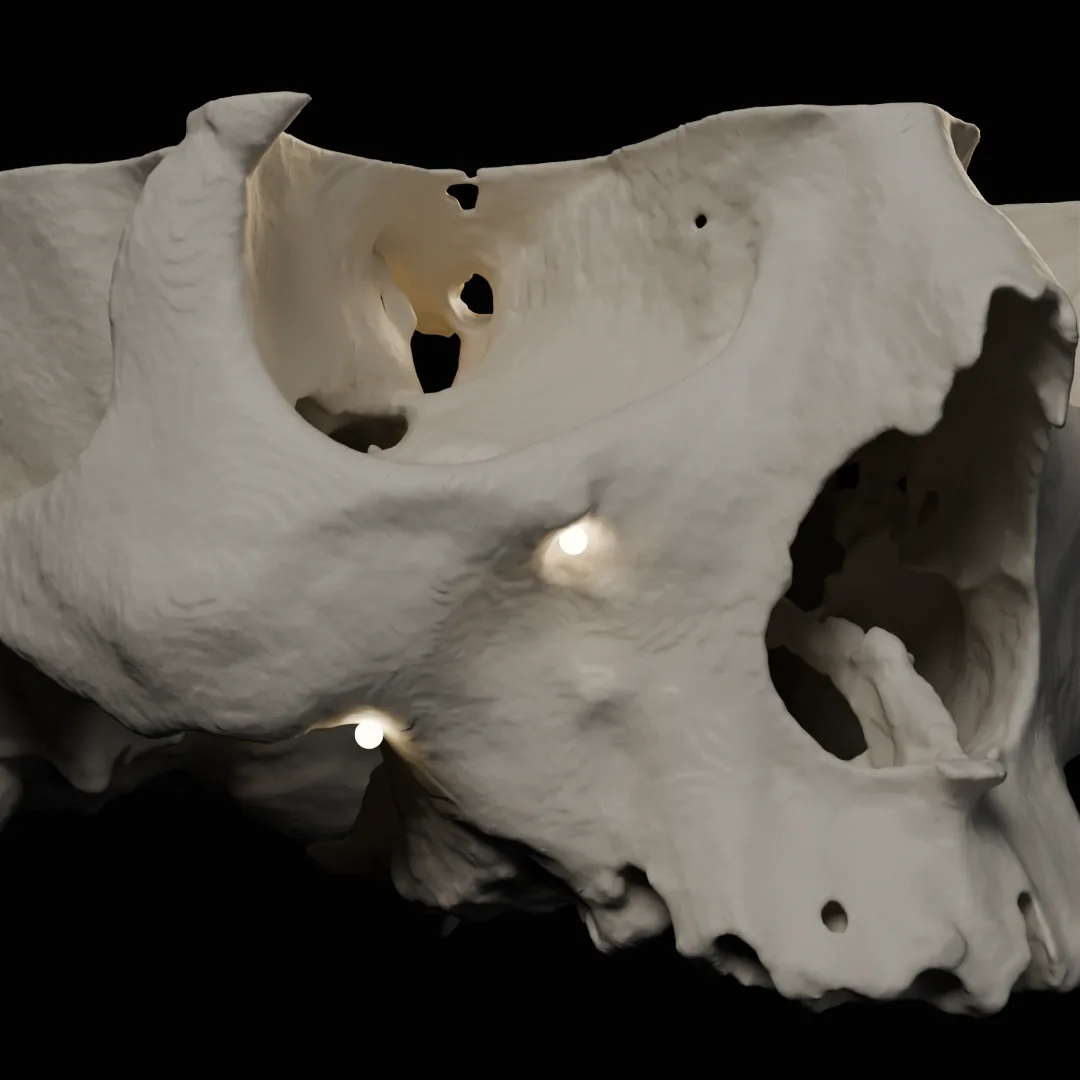
This measurement varies a lot from patient to patient.
From the infraorbital foramen to the lower end of the zygomaticomaxillary suture. On this model, 21.8 mm. How much does it change?
Each sphere is a zygoma.
362 CT scans of dentate adults. One measurement.
Altıntaş et al., 2026The largest is more than twice the smallest.
13.8 mm in the smallest. 28.8 mm in the largest. The mean is 20.4 mm, with a standard deviation of 2.4 mm.
With one retractor size…
- in the middle of the curve, retraction is ideal.
- on the sides, it gets harder.
- at the extremes, it falls short.
You have never operated on the average.
For each patient, the right size.
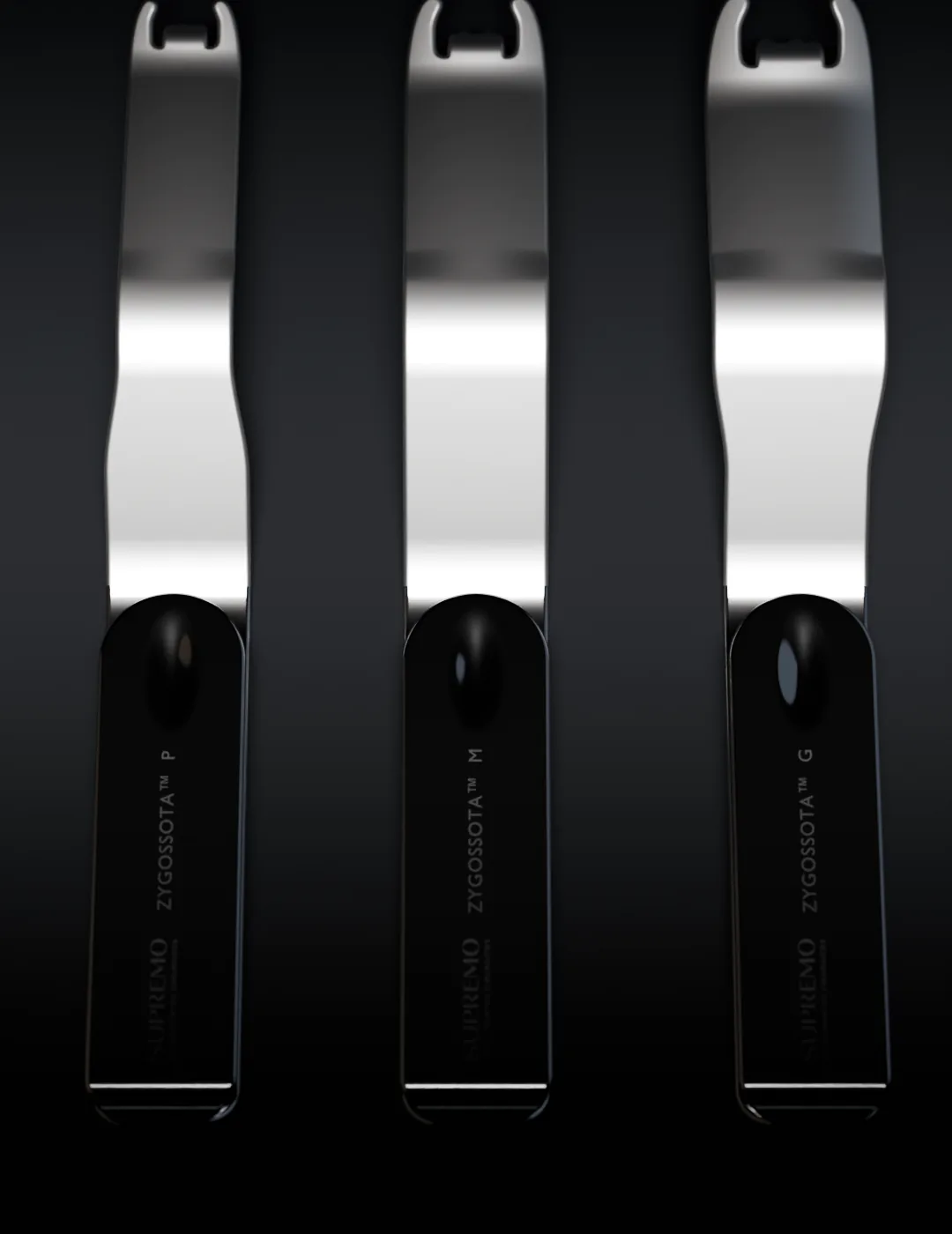
One grip, three working ends: S at 15.6 mm, M at 19.5 mm and L at 23.4 mm.
See the sizesIllustration built from the mean and standard deviation published by Altıntaş et al. (2026): the study does not publish patient-level data. The colours are illustrative: green within one standard deviation of the mean, amber within two, red beyond.
No two zygomas are alike.
One grip, three working ends. Less trauma in small faces, a proportional view in large ones. The same instrument works on both sides.
Anatomy varies. Studies measure how much.
In anatomical studies of the zygoma, the mean never comes alone: it comes with the standard deviation, the measure of how far one patient is from the next.
Zygoma thickness matters, but it is not what decides the retractor size. What counts is the height of the zygomatic body: from the orbital floor to its lower margin. The closest published measure runs from the infraorbital foramen to the inferior end of the zygomaticomaxillary suture: 20.4 ± 2.4 mm in 362 adults, from 13.8 to 28.8 mm. A single size is too large for some and too small for others.
That is why there are three. The working end is 15.6 mm wide in S, 19.5 mm in M and 23.4 mm in L. M sits close to the mean; S and L sit about one and a half standard deviations below and above.
- 20.4 ± 2.4 mm
- From the infraorbital foramen to the inferior end of the zygomaticomaxillary suture, on CT scans of 362 dentate adults (range 13.8 to 28.8 mm).Altıntaş et al., 2026
- 8.0 ± 2.1 mm
- Zygoma thickness at its thickest point, in 300 zygomata measured on CT.Hung et al., 2017
- 44.3 to 54.3 mm
- Distance from the alveolar crest to the jugale point of the zygoma: the range the authors derive from the mean and standard deviation, in 22 cadaver sides.Uchida et al., 2001
- 15.3 ± 5.6 mm
- Implant length in contact with the zygomatic bone, in 173 implants in 77 patients.Balshi et al., 2012
- Altıntaş HM, Sipahioğlu S, Cingöz G, Eberliköse H, Demir BT. CT-based morphometric analysis of the zygomatic region: infraorbital foramen localization, bone thickness, and sutural relationships. BMC Oral Health. 2026;26:1759. doi:10.1186/s12903-026-09685-6
- Hung KF, Ai QY, Fan SC, Wang F, Huang W, Wu YQ. Measurement of the zygomatic region for the optimal placement of quad zygomatic implants. Clin Implant Dent Relat Res. 2017;19(5):841-848. doi:10.1111/cid.12524
- Uchida Y, Goto M, Katsuki T, Akiyoshi T. Measurement of the maxilla and zygoma as an aid in installing zygomatic implants. J Oral Maxillofac Surg. 2001;59(10):1193-1198. doi:10.1053/joms.2001.26725
- Balshi TJ, Wolfinger GJ, Shuscavage NJ, Balshi SF. Zygomatic bone-to-implant contact in 77 patients with partially or completely edentulous maxillas. J Oral Maxillofac Surg. 2012;70(9):2065-2069. doi:10.1016/j.joms.2012.05.016
The films, with sound.
Two short films. The first shows each curve of the instrument; the second, why it comes in three sizes.
Each curve of the instrument, and what it is for.
How much the zygoma varies across 362 CT scans, and the three sizes.
Also on Instagram →Questions about the Zygossota
What is the Zygossota for?
Zygomatic implant surgery. One piece does three jobs: it holds the lip, rests on the bone and protects the drill exit. The grip is the 1.5 mm steel sheet itself, folded into a U, with no welds and no seams.
How is it different from a Minnesota retractor?
The domed blade holds the lip the way a Minnesota does. The difference is at the tip: two legs rest on the zygoma, and a tongue slides under the flap, opens the field and protects the drill exit. Hence the name: a Minnesota, but for the zygoma.
Does it work on both sides?
Yes. One instrument for the right side and the left; you don't need a pair.
What sizes are there?
Three, S, M and L, all with the same grip. Only the width of the working end changes: 15.6 mm in S, 19.5 mm in M and 23.4 mm in L. The zygoma changes from one patient to the next; your hand doesn't.
Can I buy it now?
Not yet. The Zygossota is in launch phase, and sales depend on regulatory clearance by Anvisa, Brazil's health regulatory agency. If you'd like to hear when it launches, leave your contact on the list.
Be the first to know.
Leave your contact and hear first when Zygossota arrives. Manufactured and sold by Supremo. Patent pending.
Done. You are on the list.
We will let you know when Zygossota launches, by email and WhatsApp.
SkinGuide Zygoma
The Zygossota opens the field and protects the drill exit. SkinGuide Zygoma shows where the drill should go.
Two points make a line.
And a trajectory.
One on the ridge, one on the zygoma, decided in the digital plan. A thin resin guide seats on the bone, marks the planned direction and comes off. You still work freehand, with the feel and control you already have; the virtually operated prototype gives the depth, and linear measurements are the double check.
“It isn't guided surgery. But it might as well be.”
Designed by Fernando Giovanella
The Zygossota is one part of the work. See the rest.
Fernando Giovanella is a council-registered specialist in Oral and Maxillofacial Surgery and in Implant Dentistry (CRO-SC 8237), with a master's degree in Implantology and a clinic in Blumenau, southern Brazil. Author of the book ZIGOMA 2.0 and creator of SkinGuide, he teaches the method to surgeons.
Visit the website →- Live-patient zygomatic courseFour days of live surgery in Niterói (Rio de Janeiro), with Expert Dental Solutions.→
- SkinGuide Zygoma online courseThe method, starting whenever you like.→
- SkinGuide Zygoma case planningYou send the CT scan. You get back the plan and the guides.→
- Who is Fernando GiovanellaTraining, publications and patents.→
- Instagram @drfernandogioCases, technique and teaching.→